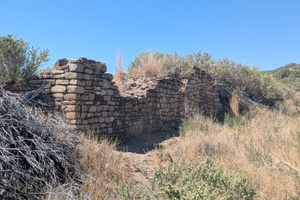

In most national parks and monuments in the Southwestern United States, one can expect certain amenities: a visitor center staffed with rangers, a bookstore, trails with interpretive signs, and at the very least, a parking lot. Yucca House has none of these things. To reach this ancestral Puebloan ruin, one must navigate a series of dirt roads through private farmland. The end point looks like someone’s driveway. The one hint you’re in the right place is a boardwalk across a grass lawn and a wooden sign pointing towards Yucca House National Monument.
The short, narrow trail to the ruins is a bit overgrown, as there are fewer than 1,000 visitors per year to help trample the soil into submission. The ruins themselves might seem unimpressive – a single wall is all that is visible, jutting out from a hill. What lies beneath the surface, however, is far more vast: the remains of a town that included over 600 rooms, 100 kivas, several towers and plazas, and one great kiva. From 1100 to 1300 CE, it was home to around 13,000 people.
While other ancestral Puebloan sites like Mesa Verde and Bandelier might seem more impressive on the surface, these ruins are partially modern reconstructions. In many cases, park rangers, archaeologists, and workers from the Civilian Conservation Corps simply made educated guesses as to what pueblos looked like in the past. Because Yucca House has been left untouched, it is a gold mine for archaeologists who use more hands-off techniques like ground-penetrating radar and aerial LiDAR mapping.
The policy of leaving sites like Yucca House unexcavated was unusual when the monument was established in the 1920s. But today, this noninterventionist approach is quite common. Many American Indian communities, especially Puebloans, prefer their ancestors’ homes to be left to the elements so that they may gradually return to the earth. Plans are in the works to build a parking lot and restroom near Yucca House, but the village itself will remain undisturbed as it has for hundreds of years. If you do make the rare trip to visit this site, please be sure to be respectful and conscientious of where you step. It is held sacred as an ancestral home for thousands of indigenous people throughout the Southwest.