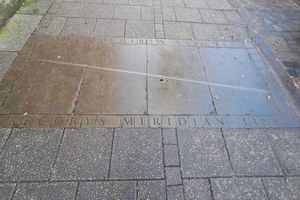

A meridian is a scientific term denoting an imaginary demarcation line that runs north to south and is drawn for astronomical purposes. The line can be used to mark zero degrees longitude and is used to divide the Earth into the Western and Eastern hemispheres, as well as to set time zones. In 1637 the Scottish astronomer and mathematician James Gregory laid down such a line in his St. Andrews laboratory.
What makes this so outstanding is that this was nearly 200 years before a similar configuration was instituted in Greenwich, England. In 1884, representatives from 22 countries gathered in Washington, DC at the International Meridian Conference with the goal of picking a global meridian that could be used to standardize navigation routes and time differences – the meridian in Greenwich was chosen and has served as the world’s prime meridian ever since.
Gregory’s Meridian was a few miles west of the one in Greenwich, creating a time difference of about 12 minutes, and placing cities like London in the Eastern hemisphere instead of the Western. Had the world not relied so heavily on England’s shipping prowess, we may have been setting our watches to STAMT (St. Andrews Mean Time) rather than GMT (Greenwich Mean Time).
In 2014, the University of St Andrews’ King James Library decided to honor this legendary inventor with a plaque and meridian line outside Gregory’s laboratory on South Street. The memorial is a brass line set on the pavement outside the King James Library – it follows the exact path of the original wooden line that he had drawn on the floor of his historic laboratory.
Today, locals and visitors alike are invited put one leg in each hemisphere and set their watches to a few minutes behind the rest of the world.